Engineered high-performance profiles, motorized pergolas, and solar-shading automation designed for local zoning ordinances and Massachusetts energy criteria.
The Greater Boston area presents an intricate set of challenges for architects, property managers, and security directors. As a historic metropolitan center flanked by the Atlantic Ocean, Boston experiences volatile coastal weather, cold winter Nor'easters, and high urban density. Protecting residential garages, retail store fronts, and industrial logistics bays in this market requires an architectural envelope that delivers uncompromising security without degrading structural aesthetics.
Traditional steel garage doors are highly vulnerable to coastal salt spray, leading to premature red rust oxidation, structural fatigue, and mechanical failure. On the other hand, standard lightweight residential doors fail to meet the forced-entry resistance standards (such as RC2 and RC3 classifications) necessary to protect high-value properties in the urban core.
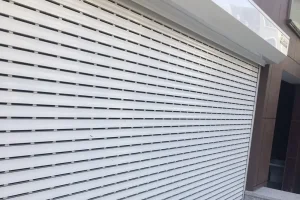
This whitepaper examines the deployment of Anti-Theft Aluminum Garage Doors within the Boston market. Engineered from structural-grade extruded aluminum alloys (specifically 6063-T6), and optimized with multi-point interlocking thermal profiles, these systems serve as a physical shield against extreme weather and malicious intrusions.
Under 780 CMR (Massachusetts State Building Code, 9th Edition), coastal zones from Boston Harbor up to Cape Ann are designated as high-velocity wind zones. Standard doors buckle under the pressure differential of a severe Nor'easter. Our systems combine structural-grade 6063-T6 alloy with internal steel reinforcements to survive wind loads up to 130 mph while preserving full anti-pry mechanical locking features.
Globally, the architectural products market is shifting rapidly from wood and standard sheet steel toward high-durability, low-maintenance engineered alloys. High-security aluminum roll-up closures and insulated sectional doors now dominate urban development projects across Western Europe, North America, and East Asia.
As a leading global manufacturer, our factories utilize automated extrusion lines, precision CNC machining, and state-of-the-art electrostatic powder coating systems that comply with Qualicoat Class 2 standards. By keeping production processes integrated in-house, we control mechanical tolerances to within tenths of a millimeter. This precision is critical for the seamless operation of heavy-duty, interlocking aluminum slats and automated anti-lift motor assemblies.
Active anti-pry mechanical locking mechanisms engage automatically when the door is shut, resisting heavy crowbar attacks.
High-density polyurethane foam injection and thermal isolation strips cut thermal transmittance to reduce energy costs.
Marine-grade architectural powder coatings withstand salt spray testing (ASTM B117) for over 3,000 hours.
Commercial and residential builders in Boston must design projects to withstand regional wind profiles. In accordance with ASCE 7-16 (Minimum Design Loads and Associated Criteria for Buildings and Other Structures), doors installed in urban Boston require wind pressure resistance capable of handling structural loads up to Class 4 (equivalent to sustained hurricane-force gusts).
Our factories address this through custom engineered end-locks and heavy-duty, deep-pocket guide rails. The security slats remain anchored within the rails even when subjected to intense pressure differentials. In addition, our products satisfy the thermal requirements of the Massachusetts Energy Code (IECC 2021 with state amendments), ensuring that heated commercial workspaces and attached residential garages minimize thermal transfer, saving building owners significant HVAC operational costs.
| Performance Metric | GRF38 Series (Residential Security) | GRF77 Heavy-Duty (Industrial/Estate) |
|---|---|---|
| Material Composition | Extruded 6063-T5 Aluminum, 1.2mm wall | Extruded 6063-T6 Structural Aluminum, 2.0mm wall |
| Forced Entry Protection | RC2 Certified (EN 1627) | RC3 Certified (High-Security Industrial Grade) |
| Wind Load Rating | Class 3 (Up to 90 mph wind loads) | Class 5 (Up to 140 mph wind loads, ASCE 7-16) |
| Thermal Performance | R-Value: 3.5 (U-Factor: 0.28) | R-Value: 6.8 (U-Factor: 0.15) with Thermal Breaks |
| Corrosion Resistance | AAMA 2604 Powder Coat (Standard) | AAMA 2605 Marine-Grade Coating (Salt Spray Resistant) |
Architectural integration in Boston is divided between two distinct aesthetics: historic landmark preservation and ultra-modern waterfront developments.
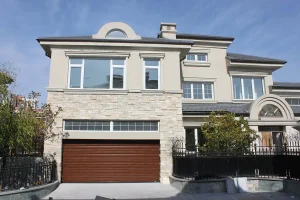
The Boston Landmarks Commission enforces strict regulations regarding exterior building components visible from public ways. Standard industrial rolling steel doors are flatly rejected. Our design team solves this by manufacturing custom aluminum sectional doors finished in woodgrain sublimation and historic-palette PVDF coatings (such as deep burgundy, forest green, and classic bronze). These doors mimic the look of 19th-century carriage-house wood doors while providing modern anti-theft security and remote smart automation.
Boston's Seaport District features modern glass-and-steel commercial towers and luxury residential high-rises. In these areas, doors must complement contemporary aesthetics and withstand storm surges and high-velocity wind loads. Our high-cycle clear-anodized aluminum doors with impact-resistant polycarbonate glazing are the ideal solution, providing natural light, sleek modern design, and robust protection.
Engineered specifically for heavy duty retail protection, high wind resistance, and thermal efficiency in northern latitudes.

The convergence of IoT integration, micro-grid clean energy, and advanced metallurgical coatings in physical security systems.
As smart-home technology and commercial facility automation become standard across New England, garage doors are evolving from simple mechanical barriers into intelligent edge devices. Our engineering roadmap focuses on integrating advanced IoT control modules directly with building management systems (BMS).
Future systems will feature integrated optical sensors, biometric entry systems, and real-time operational diagnostics that alert facility managers to maintenance needs before mechanical components fatigue. Additionally, the development of solar-integrated architectural slats will soon allow security doors to generate power, contributing to Net-Zero Energy Building (NZEB) status under regional environmental regulations.
We are currently testing nanostructured aluminum alloys that offer a 20% increase in tensile strength without adding weight. This improvement allows for thinner slat profiles with superior wind resistance, lowering motor torque requirements and extending mechanical operational cycles to over 100,000 cycles.
Every stage of production is certified to ISO 9001 and CE requirements to ensure quality and reliability.






Expert technical answers regarding structural codes, compliance, and material specifications in the Boston market.
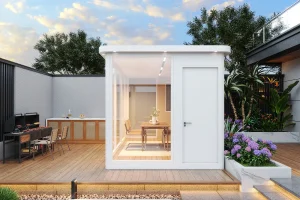
Explore our full line of outdoor enclosures, high-security insulated rolling doors, and modular spaces manufactured to global engineering standards.
Partner with a leading global manufacturer who understands New England wind ratings, historical design guidelines, and structural thermal requirements. Contact our engineering office today to receive custom CAD submittals, product specifications, and pricing.
 GARRAF