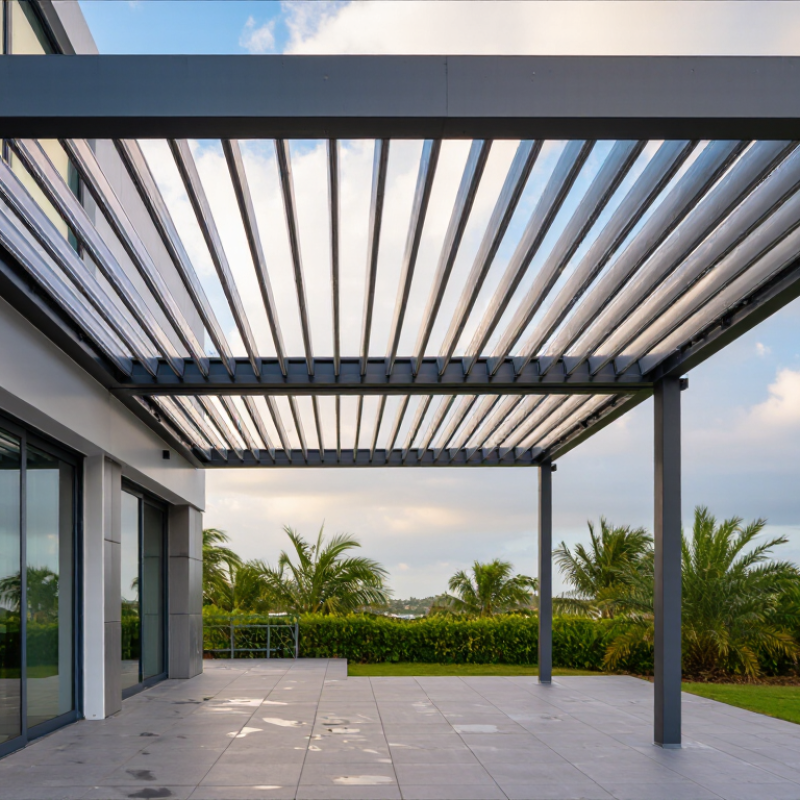
| System Structure |
Primary material |
Extruded aluminum, commonly 6063-T5 or 6063-T6 for frames, beams, posts, and louvers |
Offers a favorable balance of corrosion resistance, weight, extrudability, and structural performance |
| Louver blade type |
Hollow or double-wall aluminum blades with concealed pivot shafts |
Hollow profiles reduce weight while retaining stiffness; concealed hardware improves appearance and weather protection |
| Common blade width |
Approximately 120–250 mm, subject to structural design and manufacturer profile |
Wider blades can improve shading but may require stronger frames and actuators |
| Module configuration |
Single-span, multi-span, wall-mounted, freestanding, or roof-integrated layouts |
Allows adaptation to patios, terraces, balconies, restaurants, hospitality areas, and commercial courtyards |
| Weather Management |
Louver rotation range |
Typically about 0°–ใบ135°, depending on the pivot and control design |
Supports adjustable sunlight, ventilation, and rain protection; the actual usable angle must be confirmed in technical drawings |
| Rainwater drainage |
Gutter channels integrated into perimeter beams, with concealed downspouts in posts where applicable |
Reduces visible drainage components and directs runoff away from occupied areas |
| Wind resistance |
Project-specific calculation; commonly documented in accordance with local building codes and wind-load standards |
Do not compare systems by a generic wind number alone; request span, anchorage, louver position, and site-wind assumptions |
| Snow-load capability |
Project-specific structural rating based on snow load, span, profile, and louver position |
Critical for cold-climate installations; static and dynamic snow-management requirements should be stated in the quotation |
| Surface and Durability |
Surface finish |
Exterior powder coating, anodizing, or approved architectural coating systems |
Finish selection affects color retention, scratch resistance, maintenance, and coastal suitability |
| Coating documentation |
Request coating thickness, pretreatment process, color standard, weathering data, and warranty terms |
Provides a more reliable basis for comparing suppliers than color samples alone |
| Corrosion environment |
Standard outdoor, high-humidity, and coastal applications require different pretreatment and finish specifications |
Marine locations may require enhanced pretreatment, compatible fasteners, and more frequent inspection |
| Automation and Controls |
Actuation method |
Electric linear actuator or geared motor connected to a synchronized louver drive |
Motorized operation improves convenience and enables weather-based automation |
| Control options |
Wall switch, handheld remote, rain sensor, wind sensor, sunlight sensor, timer, or building-control integration |
Control compatibility should be confirmed before ordering, especially for multi-zone or commercial projects |
| Electrical supply |
Low-voltage and mains-voltage configurations are available; voltage and frequency vary by project and destination market |
The supplier should provide wiring diagrams, protection requirements, and local electrical compliance information |
| Weather sensor priority |
Wind protection is generally prioritized over rain or sunlight control in automated operating logic |
A defined fail-safe strategy helps protect blades and reduce risk during severe weather |
| Sizing and Installation |
Typical module size |
Many residential and light-commercial modules are engineered around spans of approximately 3–6 m; larger structures require project engineering |
Actual maximum dimensions depend on profile strength, support spacing, local loads, and drainage design |
| Foundation and anchorage |
Concrete footings, chemical anchors, expansion anchors, or engineered roof attachments, selected for the substrate |
Anchorage is a structural design item and should not be selected solely from a standard installation sketch |
| Installation scope |
Supply-only, kit supply, technical supervision, or complete installation by qualified local contractors |
Clarifying scope prevents gaps involving lifting equipment, electrical work, permits, and final commissioning |
| Applications |
Residential outdoor spaces |
Patios, terraces, balconies, gardens, poolside areas, and outdoor kitchens |
Priorities are appearance, ease of operation, drainage, shade control, and low routine maintenance |
| Commercial and hospitality |
Restaurant terraces, hotel decks, cafés, retail courtyards, event venues, and workplace outdoor areas |
Commercial buyers should evaluate duty cycle, service access, safety controls, drainage capacity, and warranty response |
| Climate-specific use |
Hot, rainy, humid, coastal, and moderate cold climates, subject to engineered local loads |
The best specification is determined by local wind, rain, snow, corrosion, solar exposure, and operating requirements |
| Global Supplier Due Diligence |
Technical package |
Request general arrangement drawings, profile sections, load calculations, drainage details, wiring diagrams, and installation manuals |
A complete technical package indicates whether the system can be properly reviewed and installed in the destination market |
| Compliance evidence |
Verify applicable local building, electrical, structural, fire, and product-safety requirements before purchase |
Compliance responsibilities differ by country and may involve an architect, engineer, inspector, or licensed electrician |
| Commercial terms |
Compare Incoterms, packaging, spare parts, lead time, payment terms, warranty exclusions, and after-sales support |
The lowest equipment price may not represent the lowest landed or lifecycle cost |
| Quality verification |
Review production drawings, material certificates, coating records, inspection procedures, sample testing, and reference installations |
Independent verification is advisable for large, coastal, high-wind, snow-load, or public-use projects |
 GARRAF